


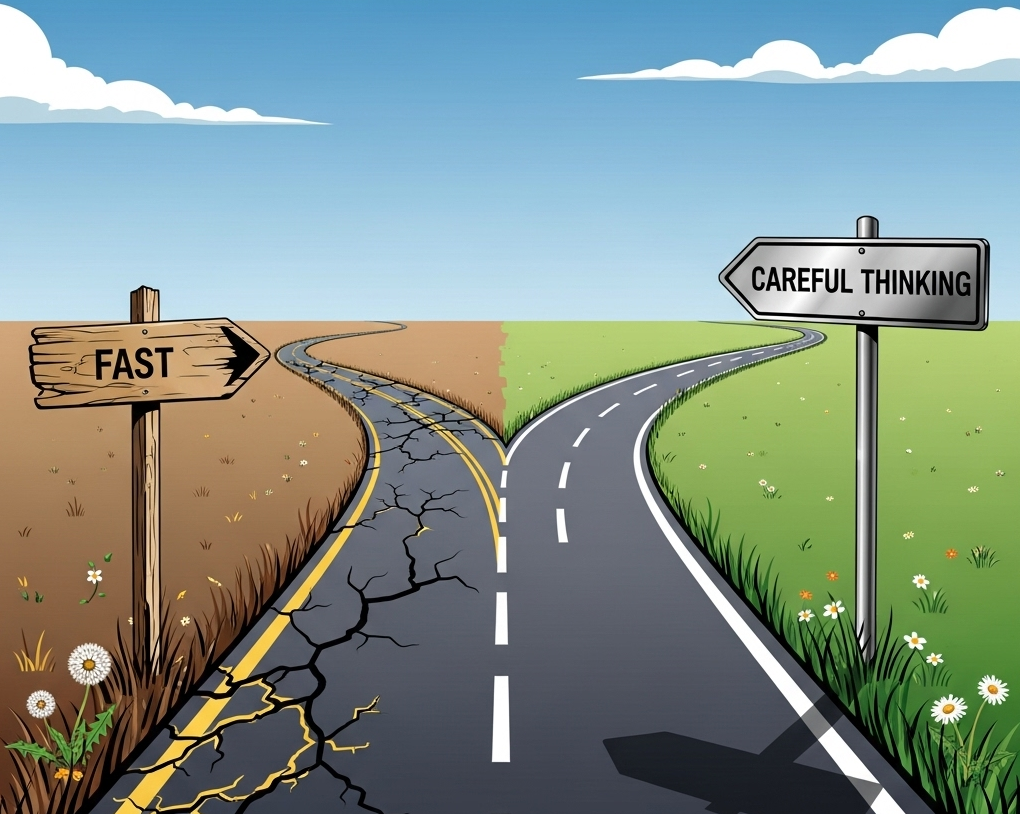
We’re all told to hustle, to move faster, to get it done now. But my biggest failures have never come from being too slow. They’ve come from being too fast. But what if the real competitive advantage isn’t speed at all?
What if the key to lasting success lies not in how fast you act—but in how well you think before you do?
Whether you’re launching a business, writing a report, managing a team, or planning your next career move, one truth remains constant: careful thinking beats reckless speed every single time.
This isn’t about being slow. It’s about being smart.
And in this article, we’ll explore why thoughtful preparation—not raw hustle—is the true engine of long-term success. You’ll learn practical strategies to build a mindset of deep consideration, avoid costly mistakes, and create work that stands out for its quality, not just its speed.
Let’s dive in.
The Myth of “Just Start” – Why Passion Isn’t Enough
We’ve all heard the advice: “Don’t overthink it—just start!”
It sounds empowering. And yes, action is essential. But here’s the uncomfortable truth: starting without thinking often leads to starting over.
Many people assume that if they love what they do, success will naturally follow. They pour their energy into a project, believing passion alone will carry them through. But reality has a way of humbling even the most enthusiastic dreamers.
You can be passionate, hardworking, and talented—and still fail.
Why?
Because effort without insight is like driving at night with the headlights off.
The Real Reason Most Projects Fail
Failure rarely comes from laziness. More often, it stems from something subtle: a missing detail, an unasked question, or a decision made too quickly.
Think about it:
- Did you validate the market need?
- Did you consider potential risks?
- Did you plan for setbacks?
- Did you ask someone with experience?
Most failures aren’t dramatic crashes. They’re quiet collapses caused by overlooked details—details that could have been caught with a few minutes of careful thought.
Insight: Success isn’t just about doing more. It’s about thinking deeper before you begin.
The Cost of Rushing – A Personal Story That Changed Everything
Let me take you back to ninth grade.
I was confident—maybe too confident—when a monthly exam came up. As soon as I glanced at the paper, I smiled. ‘Easy,’ I thought, ‘I know all this.’ So I rushed through the entire test in just 15 minutes, barely reading the questions and trusting my memory instead of my process.
When the results came back, I failed.
Not because I didn’t understand the material. Not because I hadn’t studied.
But because I didn’t think.
I didn’t pause. I didn’t reflect. I didn’t consider that confidence ≠ competence.
That moment stung. But it taught me a lesson I carry to this day:
No matter how capable you are, careless thinking guarantees failure.
Speed gave me a false sense of progress. Thoughtfulness would have given me real results.
The Wisdom of Questions – How One Conversation Saved a Business Idea
Fast forward a few years. My wife and I were newly married and full of ambition. We wanted to start a business selling tractor parts, fertilizers, pesticides, and insecticides—products we believed farmers in our region needed.
We were excited. Motivated. Ready to go.
Then my mother stepped in.
Instead of saying “no,” she asked seven simple questions:
- Do you have expertise in these products?
- Have you studied the local market—do people actually need them?
- How many competitors already exist?
- If you’re new, how will you compete?
- Do you have marketing knowledge to promote and distribute?
- What’s your financial runway if sales are slow?
- Can you afford to lose this investment?
Each question felt like a bucket of cold water.
At first, I resented it. It sounded like doubt. But later, I realized it wasn’t skepticism—it was wisdom.
She wasn’t trying to stop us. She was helping us think.
And that changed everything.
We paused. Researched. Talked to farmers. Analyzed competitors. Built a small prototype.
Eventually, we did launch—but smarter, leaner, and with far less risk.
Key Insight: Great decisions aren’t made in moments of excitement. They’re made in moments of reflection.
The Thoughtful Advantage – Why Deep Thinking Is Your Superpower
In today’s world, everyone wants to be faster. But very few people are willing to be better.
That’s your opportunity.
While others rush, you can choose to pause, reflect, and prepare. This isn’t procrastination—it’s strategic thinking.
Here’s why it matters:
1. Mistakes Are Expensive
A typo in a client email might cost you trust.
A missed step in a product launch can delay revenue by months.
One oversight in financial planning can trigger a cash flow crisis.
Careful thinking prevents these losses before they happen.
2. Quality Builds Trust
Think about it—do you go back to the restaurant that served you a sloppy meal in two minutes, or the one that took its time and got it right? It’s the same with our work. Reliability is what builds a reputation, and that’s something you can’t rush.
When you deliver something accurate, thorough, and well-considered, people notice. They refer you. They hire you again. They trust you with bigger projects.
Trust is earned not in seconds, but in consistency.
3. Prevention Beats Correction
Fixing a problem takes 5–10 times longer than preventing it.
Imagine spending two hours carefully outlining a presentation vs. rushing into slides and realizing halfway through you’re missing key data. Which saves more time?
Spoiler: The upfront thinking.
So how do you actually do this?
After years of practice, I’ve developed a few simple habits that keep me from repeating the same mistakes. Here’s what has worked for me.
How to Build a Thoughtful Mindset: My 5-Step Method
Step 1: Pause Before Acting
Before diving into any task, stop for 60 seconds. Ask yourself:
- Why am I doing this?
- What’s the desired outcome?
- What could go wrong?
This tiny pause resets your brain from “reactive” to “strategic.”
Pro Tip: Use a “pre-action checklist” for recurring tasks (e.g., sending emails, starting projects).
Step 2: Ask the Right Questions
These are the kinds of questions my mother asked me, and they force you to move from excitement to strategy.
| QUESTION | PURPOSE |
| 1. Do I have the skills/knowledge for this? | Assess capability |
| 2. Who is this for, and do they really need it? | Validate demand |
| 3. Who else is doing this? | Analyze competition |
| 4. What’s my unique advantage? | Define differentiation |
| 5. What resources do I need? | Plan logistics |
| 6. What could go wrong? | Risk assessment |
| 7. How will I measure success? | Set KPIs |
Answering these turns blind effort into targeted action.
Step 3: Test Small Before Scaling
Avoid “all-in” moves. Instead, use micro-experiments.
For example:
- Want to start a blog? Write 3 posts first.
- Launching a service? Offer it to 3 free clients for feedback.
- Creating a product? Build a prototype before manufacturing.
Small tests reveal flaws early—without major cost.
Creative Strategy: Call your first version a “Learning Launch.” This removes pressure and encourages iteration.
Step 4: Schedule “Thinking Time”
Most people only think when problems arise. Proactive thinkers schedule reflection.
Try this:
- Block 20 minutes every Friday for “Review & Reflect”
- Ask: What worked? What didn’t? What did I miss?
- Update your processes accordingly.
Over time, this builds a learning loop—where each project makes the next one stronger.
Step 5: Embrace the “Second Draft” Mentality
First ideas are rarely the best.
Apply this rule: Nothing ships until it’s had a second look.
Whether it’s an email, a design, or a business plan—sleep on it, revisit it, refine it.
Even Steve Jobs famously said:
“Real artists ship.”
But he also revised relentlessly.
Shipping fast and well requires editing, not rushing.
Speed Has Its Place – But Only After Thought
Let’s be clear: speed isn’t the enemy.
In fact, once you’ve done the groundwork, speed becomes your superpower.
The goal isn’t to be slow—it’s to be fast at the right time.
Think of it like a race car:
- In the garage: meticulous tuning, tire checks, fuel levels.
- On the track: full throttle.
Rushing the prep means crashing on the course.
But preparing deeply? That lets you accelerate with confidence.
Balance Formula:
Thoughtfulness × Preparation = Sustainable Speed
Unique Tips to Think Deeper (Beyond Common Advice)
Most articles stop at “think before you act.” Let’s go further with fresh, actionable strategies:
Use the “Enemy Review” Technique
Ask: If my competitor wanted to destroy this project, how would they do it?
This reverse-engineering exposes weak points you’d otherwise miss.
Set a “Mistake Budget”
Before starting, decide: “I’m allowed X mistakes. How can I avoid using them?”
This creates mental accountability and reduces carelessness.
Talk to the “Unimpressed Expert”
Imagine presenting your idea to someone brilliant but skeptical. What would they challenge?
Role-playing this conversation forces you to strengthen your logic.
Write a “Failure Forecast”
Spend 10 minutes writing: “Here’s why this could fail…”
List every possible flaw. Then address them one by one.
This isn’t pessimism—it’s proactive problem-solving.
Real-World Applications – Thoughtfulness in Action
For Employees:
Before submitting a report, ask:
- Is the data accurate?
- Are the conclusions supported?
- Would my boss need to ask follow-ups?
A single extra review can elevate you from “competent” to “indispensable.”
For Managers:
Before rolling out a new policy, pilot it with one team. Gather feedback. Adjust.
This prevents company-wide frustration and increases buy-in.
For Entrepreneurs:
Before spending $1 on ads, answer:
- Who exactly is my customer?
- What problem do I solve for them?
- Why should they trust me over others?
Clarity here determines profitability.
The Long-Term Payoff – Why Thoughtful People Win
Careful thinkers may seem slower at first. But over time, they win because:
- They make fewer mistakes → save time and money
- They build stronger reputations → earn referrals
- They learn faster → improve continuously
- They avoid burnout → sustain momentum
Meanwhile, the “fast movers” often burn out, rebuild, or fade away after early hype.
Truth: Lasting success isn’t a sprint. It’s a series of well-thought-out steps in the right direction.
Final Advice – Make Thoughtfulness a Daily Habit
Here’s your takeaway:
Stop glorifying speed. Start honoring depth.
Every time I’m about to rush, I try to remember that ninth-grade test paper.
“Am I doing this quickly—or am I doing it right?”
Then choose wisely.
Remember:
- Speed gets attention.
- Quality earns respect.
- Thoughtfulness ensures longevity.
If you want to stand out in your job, business, or personal growth, master the art of thinking before acting.
Because when you do, success doesn’t chase you.
It finds you—naturally, consistently, and deservedly.
Call to Action: Start Today
Don’t wait for a failure to change your approach.
- Pick one task you’re working on right now.
- Pause. Ask 3 thoughtful questions.
- Make one improvement before you continue.
Small shifts create big results.
And if this resonated with you, share your story in the comments below:
Have you ever rushed into something—only to regret it later? What did you learn?
Let’s build a community that values wisdom over haste.
