


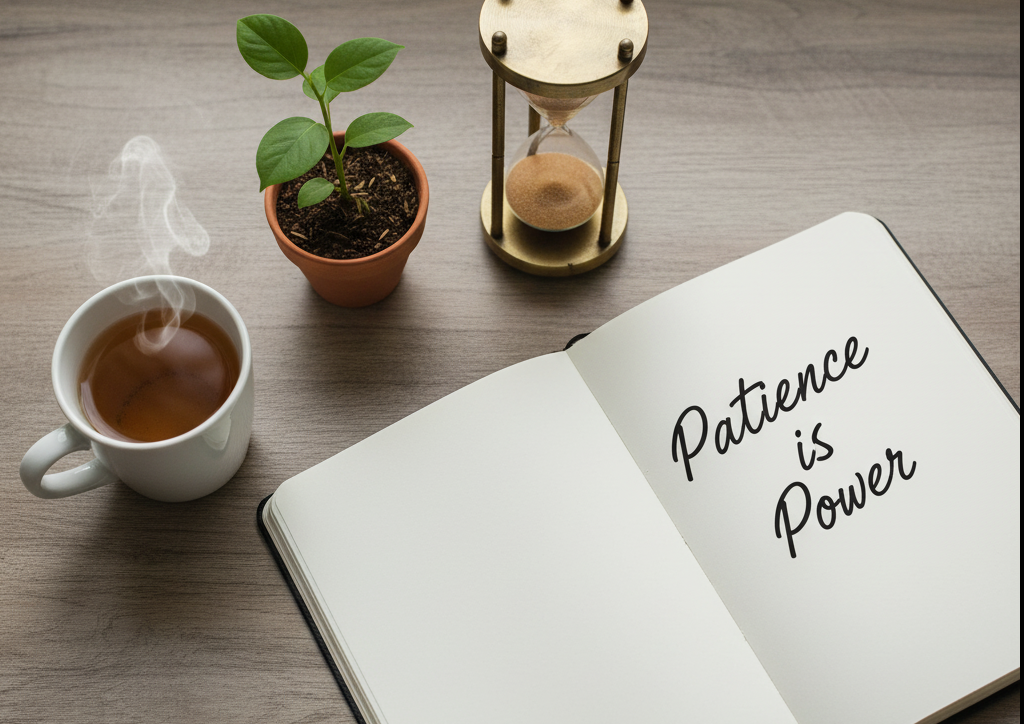
“Great things are done by a series of small things brought together.”
— Vincent Van Gogh
The Hidden Superpower No One Talks About
We live in a world obsessed with speed—instant replies, same-day delivery, overnight success. We’re told to value hustle, grit, and raw talent above all else. But when I look at the people and things that truly last, I see a different, quieter force at play: patience.
It’s the quiet discipline of waiting well — of trusting timing over urgency — that separates those who burn bright from those who burn long.
If you want something to last — a relationship, a career, a dream — you cannot rush it. Great things grow slowly, like trees, not like fireworks. And just like a tree needs time, sunlight, and deep roots, so do meaningful achievements.
This isn’t about doing nothing. It’s about doing the right thing at the right time.
Welcome to the quiet power of patience — the most underrated force in personal growth, business, and life.
Why We Rush (Even When We Know Better)
We all know we should be patient. But why don’t we?
Because everything in modern life trains us to see slowness as a threat. It feels like if you’re not moving, you’re falling behind. We’re bombarded with messages like:
- “Be first.”
- “Launch fast.”
- “Move before your competition does.”
And so, we rush — even when our gut says to wait.
Here’s what drives that urgency:
Fear of Missing Out (FOMO)
You see someone land a dream job, close a big deal, or go viral — and suddenly, you feel behind. You think: “If I don’t act now, my chance will vanish.”
But I’ve learned something over the years: real opportunities aren’t fragile, one-time events. They circle back around for the people who are actually ready. When you rush out of FOMO, you end up with half-baked ideas and partnerships that never feel quite right.
Social Pressure and Arbitrary Timelines
“You should be married by 30.”
“You should own a house by 35.”
“You should be making six figures by 40.”
These invisible clocks create false urgency. But real growth doesn’t follow calendars — it follows rhythm.
When you let society define your timeline, you trade authenticity for appearance.
Impatience with Progress
You’ve been working hard, but the results are slow. No promotion. No sales. No breakthrough.
So you pivot too soon. Quit too early. Switch strategies mid-flight.
But mastery requires repetition. Momentum builds beneath the surface — long before you see visible change.
Comparison Is the Thief of Peace
They launched a course in three weeks. You’ve been planning yours for three months.
They got funding on their first pitch. You’re still refining your deck.
Comparison distorts reality. What you see is the highlight reel — not the years of failed attempts, late nights, or silent struggles.
And rushing to “catch up” only delays true success.
Lack of Trust in the Process
Deep down, many of us doubt whether our efforts will pay off. So instead of letting things unfold, we try to force them.
We overwork. Over-promise. Over-sell.
But nature doesn’t respond to force — it responds to consistency.
As my mechanic once said: “You paid to rush — but rushing broke it more.”
Let that sink in.
The Strength of Stillness in a World That Never Stops
Stillness isn’t laziness. It’s a strategy.
The wisest people I know aren’t the ones frantically chasing every trend. They’re the ones who quietly prepare. When chaos hits, they don’t panic; they have a plan. They’ve learned to respond thoughtfully instead of just reacting.
Patience gives you something rare: clarity.
When everyone else is scrambling, you can see patterns. Spot risks. Hear feedback others miss.
Real Examples of Patience in Action
In Business:
Sara Blakely, founder of Spanx, spent two years developing her product prototype — folding pantyhose in her apartment, testing materials, and learning patents. She didn’t launch until she was ready.
Result? A billion-dollar brand built without investors — because she trusted her timing.
In Relationships:
A couple I know waited five years before getting engaged. Friends called them “old-fashioned.” But today, after 18 years of marriage, they say: “We weren’t delaying love — we were building trust.”
In Skill Mastery:
J.K. Rowling wrote Harry Potter over five years. Rejected by 12 publishers. She could’ve rushed a rewrite after each “no.” Instead, she revised thoughtfully — and stayed faithful to her vision.
Her patience created a cultural phenomenon.
My Personal Lesson in Impatience (And What It Cost Me)
Five months ago, I had a critical meeting across town. My motorbike broke down the night before.
Instead of taking it to my trusted mechanic the next morning, I panicked. Found a “quick-fix” shop. Paid extra for “urgent service.” The guy promised it’d be ready in two hours.
It ran… for two days.
Then the same problem returned — worse than before.
When I finally took it to my regular mechanic, he smiled and said:
“You didn’t let the engine cool before restarting. That’s why it failed again. You paid to rush — but rushing broke it more.”
Standing there, smelling the burnt oil, I felt like an idiot. He was right. In my panic to save an hour, I’d created a two-day problem. I hadn’t just confused urgency with importance—I had paid extra for the privilege of making things worse. I wanted a fast fix, not a lasting solution.
And that’s exactly how people sabotage their goals every day.
You can pay to speed things up — but you can’t pay to skip the process.
How Impatience Destroys Opportunity (Silently and Completely)
Impatience doesn’t always explode — sometimes, it erodes.
Here’s how rushing quietly kills your potential:
1. Careless Mistakes Multiply
When you’re in a hurry, details get missed. Contracts signed without reading. Emails sent with typos. Promises made without thinking.
One typo in a proposal cost a friend $50K in lost funding. All because he was rushing to “beat the deadline.”
2. You Mistake Red Flags for Green Lights
You meet someone who seems perfect — closes deals fast, talks big, promises results. You jump in.
But if you’d waited, you’d have noticed: inconsistent communication, vague answers, pressure to commit quickly.
Patient people ask questions. Test assumptions. Watch behavior over time.
3. Desperation Pushes People Away
Have you ever worked with someone who constantly checks in? “Did you see my message?” “Are we moving forward?” “Can we do this tomorrow?”
It feels pushy. Needy. Unstable.
People don’t resist commitment — they resist pressure.
Calm confidence attracts. Panic repels.
4. Energy Burns Out Before Results Arrive
Think of your effort like fuel. Rushing burns it in minutes. Patience makes it last months.
A client launched a course in six weeks — promoted nonstop, worked 80-hour weeks. By month three, she was exhausted. Sales stalled. She quit.
Another took six months to build her audience, refine her content, and test messaging. Launched quietly — and scaled steadily.
Guess who’s still in business?
5. Reputation Suffers Long-Term
Once people label you as “always in a hurry,” they stop trusting your judgment.
They assume you’ll cut corners. Break promises. React emotionally.
But the person who waits? Who listens? Who delivers consistently?
They become the go-to expert — not because they’re the fastest, but because they’re the most reliable.
The Qualities of Truly Patient People (And How to Develop Them)
Patience isn’t passive. It’s active resilience.
Here’s what patient people do differently — and how you can adopt these habits:
1. They Think in Seasons, Not Seconds
They understand that growth has phases:
- Planting (learning)
- Growing (practicing)
- Harvesting (achieving)
They don’t expect fruit in winter.
Map your current goal on a seasonal timeline. What phase are you in? Are you trying to harvest during planting season?
2. They Listen More Than They Speak
They gather information before acting. They observe team dynamics. Study market trends. Hear customer pain points.
Listening is preparation in disguise.
For one week, practice the 70/30 rule: listen 70% of the time, speak 30%. Notice how your decisions improve.
3. They Celebrate Small Wins
Progress isn’t always loud. Sometimes it’s a single email reply. A new follower. A skill practiced for 20 minutes.
Patient people honor these moments — because they know compound growth starts small.
Keep a “Tiny Wins Journal.” Write one small win daily. After 30 days, review it. You’ll be amazed.
4. They Trust the Timing of Their Life
They don’t compare their Chapter 3 to someone else’s Chapter 20.
They believe their path has its own rhythm — and that delayed doesn’t mean denied.
Write a letter to your future self. Describe where you want to be in 3 years. Then, list 3 patient actions you can take now to get there.
Lessons from My Uncle, the Farmer (Nature’s Greatest Teacher)
I have this vivid memory of my uncle, who farmed rice for forty years. I was younger, full of ideas, and asked him why he didn’t use some of the newer, faster machines. He just pushed his hat back, wiped the sweat from his forehead, and looked out over the fields. ‘This land has its own clock,’ he said. ‘You force it, you get a quick harvest. You respect it, you get a healthy farm for your kids.
That stuck with me.
Nature teaches us that timing matters more than effort.
You can water a seed every hour — but if it’s not time to sprout, nothing happens.
You can hustle every day — but if the market isn’t ready, traction won’t come.
Patient people don’t just wait — they work while they wait:
- Learning
- Building relationships
- Improving systems
- Refining their craft
They prepare so thoroughly that when opportunity knocks, they answer with confidence — not desperation.
Choose Your Company Wisely — Who Are You Walking With?
Pay attention to the energy of the people you surround yourself with. Some people operate in a constant state of urgency. They’re exciting, they’re charismatic, but their pace creates chaos. Others are more grounded. They might not be as flashy, but they build things that last. It’s tempting to run with the sprinters, but you’ll build a better life walking with the marathoners.
Impatient people create chaos. They pressure you into bad decisions, break trust, and leave messes behind.
Patient people build stability. They help you think clearly, avoid traps, and grow sustainably.
Your environment shapes your mindset. Choose wisely.
The Mark of a Truly Grounded Person
A grounded person doesn’t panic when things slow down.
They don’t rage-quit when growth stalls.
They see delays as preparation, not punishment.
They trust the process — not because everything works out, but because they’ve learned that meaningful things take time.
And because of this calm, others naturally gravitate toward them:
- Employees want to work for them.
- Clients want to hire them.
- Friends want to confide in them.
In a world addicted to speed, being steady is revolutionary.
How to Cultivate Patience (Even If You’re Naturally Impatient)
You’re not born patient — you become it.
Here are 5 practical strategies to build patience like a muscle:
1. Practice Delayed Gratification Daily
Start small:
- Wait 10 minutes before buying something online.
- Pause 5 seconds before replying to an angry text.
- Let a colleague finish speaking before responding.
Each small delay strengthens your patience reflex.
2. Set Process-Based Goals (Not Just Outcome Goals)
Instead of: “Make $10K this month”
Try: “Send 5 personalized outreach emails per day.”
Focus on what you control — not just the result.
3. Use the “Wait, Then Act” Rule
Before any big decision, impose a 24–72 hour cooling period. Sleep on it. Ask: “Will this matter in 6 months?”
Most rash decisions fail this test.
4. Visualize the Long Game
Create a “Vision Timeline” — sketch your ideal life in 1, 3, and 5 years. Post it where you’ll see it daily.
When impatience strikes, look at the timeline. Remind yourself: This is a marathon.
5. Reflect Weekly
Every Sunday, ask:
- Where did I rush this week?
- What would have happened if I’d waited?
- What small progress did I overlook?
Awareness precedes change.
Final Thought — Be the Oak, Not the Firework
Fireworks dazzle for seconds.
An oak tree shelters generations.
Which legacy do you want?
Greatness isn’t built in bursts — it’s built in consistent, patient action.
You don’t need to be the fastest.
You don’t need to be the loudest.
You just need to keep going — calmly, wisely, relentlessly.
So the next time you feel the urge to rush, pause.
Breathe.
Ask: “Am I respecting the process — or fighting it?”
Then choose patience.
Because in the end, the ones who last… are the ones who waited well.
Call to Action: Share Your Story
Have you ever rushed into a decision — and regretted it?
Or waited patiently — only to be amazed by the outcome?
Drop your story in the comments below.
Let’s build a community that values depth over speed, timing over haste, and peace over panic. Your experience could be the insight someone else needs to keep going.
And if this resonated, share it with someone who’s moving too fast — they might just need this reminder.
